Francoist Spain
The Shadow of the WindFrancoist Spain forms the repressive backdrop to the novel’s postwar Barcelona, where state power reaches from public propaganda into the bookshop, the streets, and private relationships. The period is conveyed both through ordinary urban routines and through the continued threat of political violence.
Public Life and Official Progress
The regime’s claim to national progress appears in the newspaper assembled by Fermín Romero de Torres from scraps he has rescued from a waste bin. Its lead story praises public works as proof of the dictatorship’s achievements; Fermín’s bitter response to another dam exposes the distance between official celebration and the experience of people living at the margins. His sardonic commentary gives political criticism a voice even in the precarious setting of his lodgings beneath the arches of Calle Fernando.
Modernization also enters the city as a promise of transformation. A Philips poster announces television as a new marvel, while the streets fill with cars and Barcelona’s established rhythms continue around them. Fermín predicts that television will bring cultural decline, turning technological optimism into another occasion for his satire. These details place the dictatorship’s public language of progress beside a more skeptical view of what progress means in daily life.
Police Authority and Intimidation
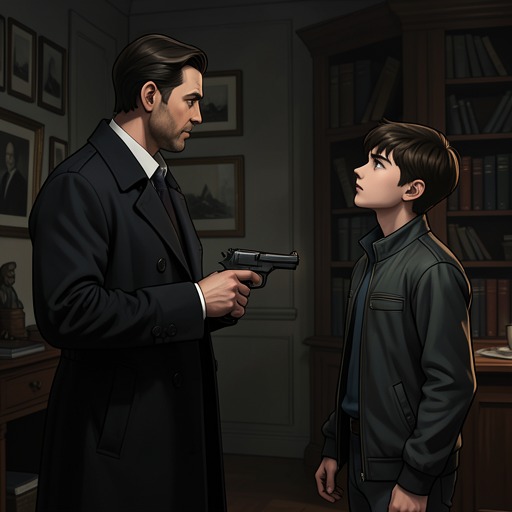
The regime’s authority is made immediate through Chief Inspector Francisco Javier Fumero. At the bookshop, he displays his police identification and threatens Daniel and his father with trouble for selling communist material. The encounter shows how police power enters ordinary commercial life: a shop that circulates books can be treated as politically suspect, and the threat alone is enough to leave Daniel unable to answer.
Fumero’s authority is not confined to warning and surveillance. When he confronts Fermín and Daniel at the Hospice of Santa Lucia, he threatens to take them to headquarters and subject Fermín to another session of torture. His reference to an earlier abuse makes clear that coercion is not an exceptional possibility but part of the continuing power he exercises over people he targets.
Wartime Violence and Its Continuation
Fermín’s account traces that violence back to the war and the fall of Barcelona. He had been working to keep watch on men such as Fumero; after the city fell, he became a persecuted criminal, and his superiors were forced into hiding. The ensuing purge was carried out openly, including shootings in the streets and at Montjuic Castle. Arrested at the port while trying to secure passage to France for some of his superiors, Fermín was imprisoned and tortured by Fumero and an accomplice. He eventually gave up information under duress, was abandoned in an alley in Pueblo Seco, and was cared for by a woman for two months.
The effects of this history remain visible long afterward. When Fermín collapses, a doctor identifies his scars as injuries caused by torture. His later recollection explains their origin, but also distinguishes the physical marks from the lasting internal consequences. The novel thus links the state’s past violence to a survivor’s continuing vulnerability in the postwar city.
A City Shaped by Repression
Barcelona’s urban spaces register both continuity and change. The Ramblas, Calle Arco del Teatro, and the Raval form part of Daniel’s early-morning route through a city of old buildings and narrow streets; later, cars, traffic lights, and the prospect of television suggest a changing urban life. During a storm, a blackout leaves the streets empty and dark, interrupting the routine confidence of the modern city. These settings do not by themselves explain political events, but they make the public world in which characters move feel exposed to uncertainty and danger.
The novel’s account of Francoist Spain is therefore built from more than overt political declarations. Propaganda and consumer modernity coexist with censorship, threats, persecution, and violence carried forward from wartime purges. The contrast gives the period its defining tension: public claims of order and advancement stand alongside private fear and the unresolved consequences of repression.